Biweekly mortgage halves and PMI removal
How Ample models half-payments every payday the way the servicer applies them, plans the two extra halves in 3-paycheck months, judges PMI on the first lien against a defensible value, and drafts the letter.
Updated September 5, 2026 · 3 min read
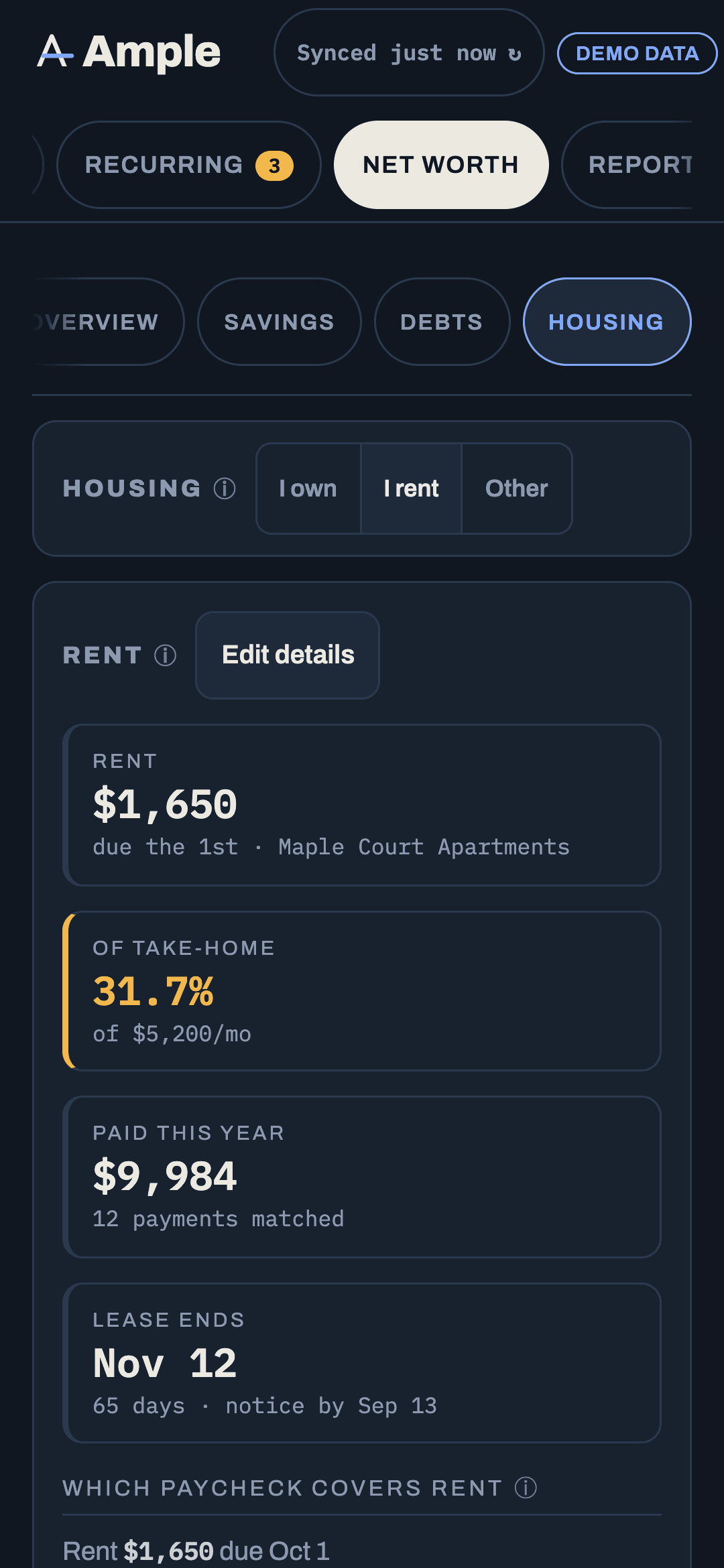
The Home page under Net worth holds the mortgage model. It is built to match how servicers actually behave, and it takes its numbers from your connected loan and the details you enter.
Set up the mortgage
Open Net worth › Home › Edit details and enter or confirm: the first-mortgage balance and rate (from the connected loan if your servicer links), the total monthly payment and its escrow lines (tax, insurance, mortgage insurance), the home's appraised value at purchase, and whether the servicer drafts half-payments every payday. If there is a second lien (a HELOC or down-payment-assistance loan), enter it too; it matters for disclosure, not for the PMI math.
Principal and interest is whatever is left after the escrow lines. Escrow never amortizes; it passes through to the tax and insurance bills.
Biweekly halves, the servicer's way
With half-payments on, Ample deducts half the total payment on every payday in the paycheck plan, so the checking buffer is never surprised. It models the servicer holding a half in suspense until the second half completes a payment, and it walks your real payday calendar rather than assuming one lump a year. In a month with a third payday, the third half has nothing to complete, so it is applied entirely to principal.
That is two extra halves a year, one whole payment, and Ample places them in the exact months they will land. The Home card shows Monthly vs Biweekly from the same amortizer: payoff date, total interest, months saved, and the month the balance crosses 80% loan-to-value under each.
If your servicer handles the extra half differently, set it in Edit details; the model follows what you tell it, not a generic rule.
PMI is judged on the first lien alone
Private mortgage insurance is on the first mortgage, so the loan-to-value that matters is the first-lien balance divided by value. A second lien does not change it. Ample shows first-lien LTV on the Home card and marks 80%.
Which value
The purchase appraisal is one value. Ample also keeps an Adjusted value: appraisal × area appreciation since purchase, plus a renovation ledger where each project carries a cost and a cost-recouped factor you can edit. Every line is visible and arguable. The Home card lets you toggle between the two, and Net worth can show either.
When first-lien LTV on a value you can defend reaches 80%, PMI removal appears as a Move with the yearly saving. Approving writes the letter with your numbers: balance, value and its basis, LTV, loan number, the legal ground. Send it, mark it sent, and record the reply.
The 78% and midpoint rules
Ample also shows the month the scheduled amortization reaches 78% of the original value, when the servicer must terminate PMI automatically if you are current, and the loan's midpoint, the outside date. These need no letter; Ample flags the month so you check the statement.
Refinance check
The Home card runs a refinance comparison on a principal-and-interest basis with closing costs included and, if there is a second lien, whether the refinance would have to pay it off. A refinance appears as a Move only when the break-even is inside your horizon; the arithmetic is on the card either way. See the biweekly mortgage guide and the PMI removal guide for the same math without an account.
Still stuck?
Tell us what you were trying to do and what happened. A person reads every message.
Contact support